


We live in a world filled with opinion.
You can go to YouTube or your news channel of choice and get an avalanche of outlooks on politics and where the stock market is going.
The thing about it is that the stock market doesn't really care about anyone's opinion.
The market does what it wants not what it is told.
Michael Cembalest, Chairman of Market and Investment Strategy for JP Morgan, put it this way in his most recent article:
Here’s the interesting thing about the stock market: it cannot be indicted, arrested or deported; it cannot be intimidated, threatened or bullied; it has no gender, ethnicity or religion; it cannot be fired, furloughed or defunded; it cannot be primaried before the next midterm elections; and it cannot be seized, nationalized or invaded. It’s the ultimate voting machine, reflecting prospects for earnings growth, stability, liquidity, inflation, taxation and predictable rule of law.1
Recently, it hasn't been pleased, and it's been prone to volatility.
The stock market can be moody. Howard Marks, back in the 1990s, noticed this:
The mood swings of the securities markets resemble the movement of a pendulum. . . . between euphoria and depression, between celebrating positive developments and obsessing over negatives, and thus between overpriced and underpriced. This oscillation is one of the most dependable features of the investment world, and investor psychology seems to spend much more time at the extremes than it does at a “happy medium.”2
Turns out we can be moody too.
If you invest based simply on your mood, you are likely going to get in trouble as an investor. And right now, there is a potentially flammable mix of not only your feelings about the market but your feelings about politics to bear down on your investment decisions.
Peter Mallouk described it in his recent LinkedIn post:
The rhetoric and policies coming out of the Trump administration - whether one agrees with them or not - has many people more on edge. There’s a lot more sensitivity around political influence on markets. There are few things people are more sensitive to than politics and money. Mix them together and you get an emotional firestorm for some.3
This is where operating according to an investment plan can trump—pun intended—operating according to the current mood of the market.
The stock market via the S&P 500 entered a “correction” (the term for a 10% decline) this past week, but the market vibe has felt even worse. Two reasons for that are, yes, politics and the fact that some areas of the market have been hit far harder than others.
Sometimes you need to step back and look at the big picture.
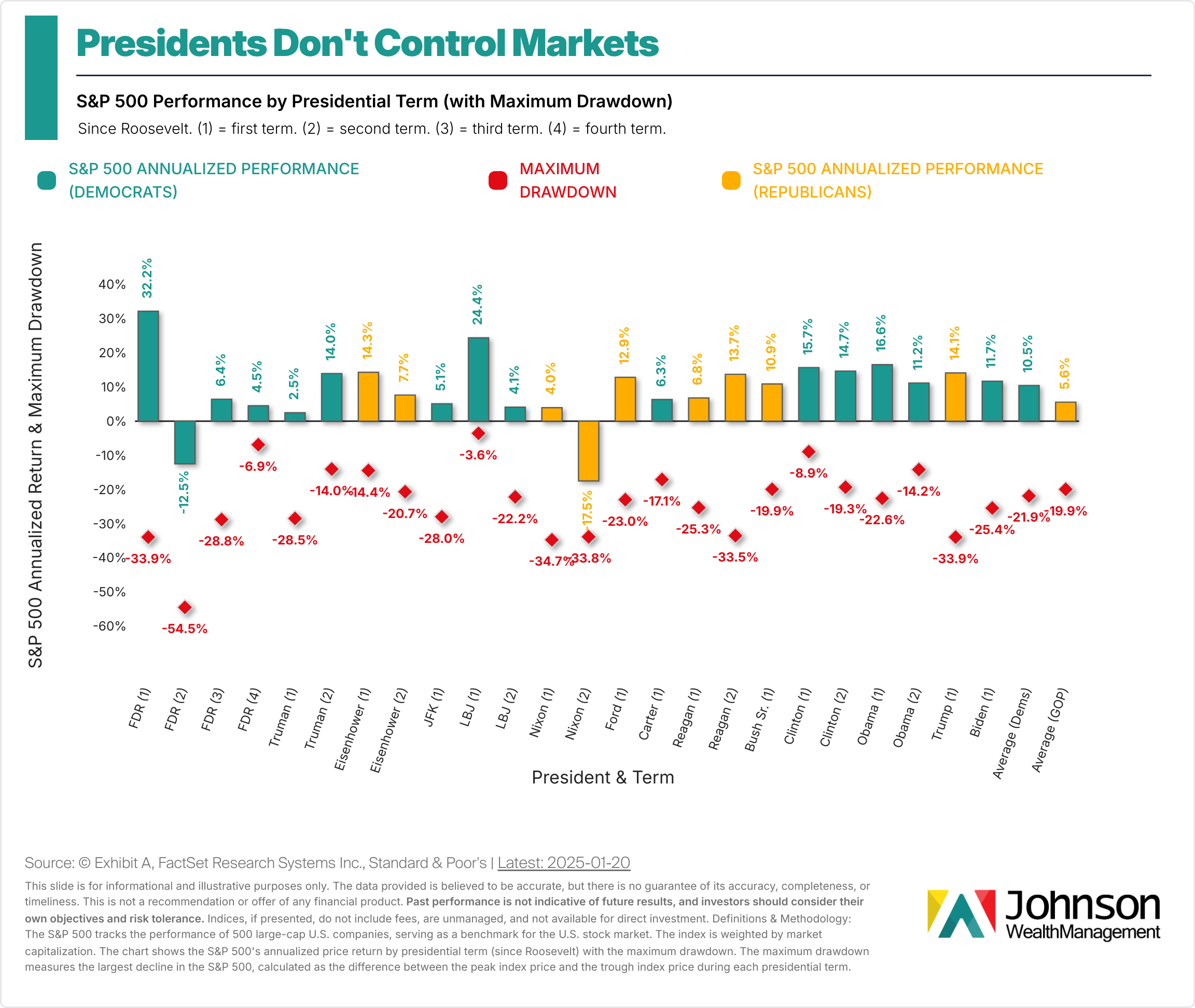
Remember stock drawdowns—many much larger than the current selloff—have occurred regardless of who is in the White House.
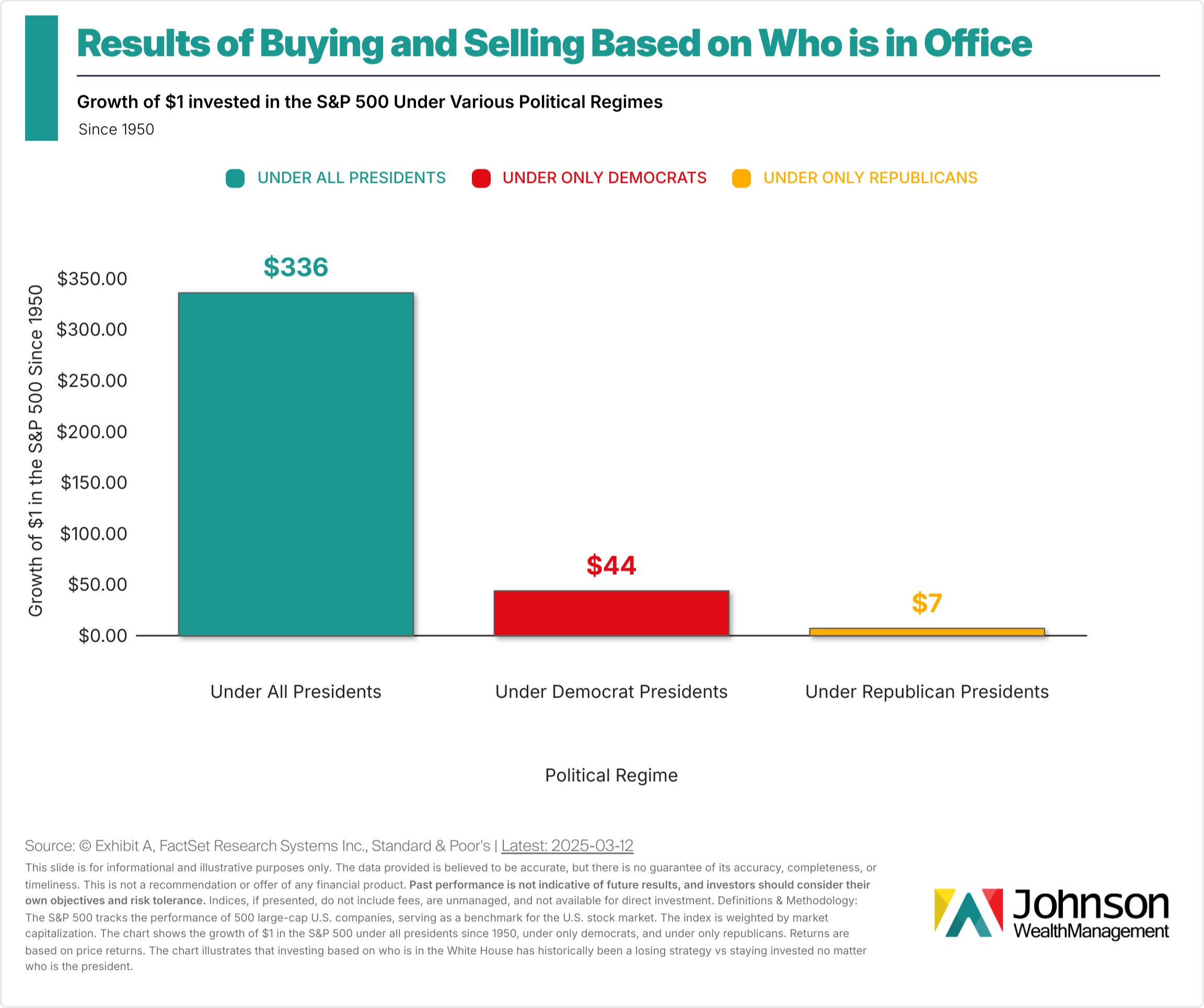
More importantly, investors who have stuck with investing have done far better than the ones who made investment decisions based on the donkeys or elephants in the Oval Office.
This is where an investment plan comes in that is by its very nature intended for the future and not for the now.
Don't forget that if you need money now—whatever that amount is—it probably shouldn't be in stocks in the first place.
Here are some questions to ask yourself:
· What's the purpose and goal of my investments? The Why.
· When do you need the money? The When.
· How will you get there? The How.
Don't let your why get crushed by the now.
Living life like a pendulum usually doesn't work in life or in investing.
----
Sources:
1. Eye on the Market, March 12, 2025. Accessed online: https://assets.jpmprivatebank.com/content/dam/jpm-pb-aem/global/en/documents/eotm/fifty-days-of-grey.pdf
2. April 11th, 1991 memo. Accessed online: https://www.oaktreecapital.com/docs/default-source/memos/1991-04-11-first-quarter-client-performance.pdf?sfvrsn=d7bd0f65_2
3. Posted on March 13, 2025. Accessed online: https://www.linkedin.com/posts/peter-mallouk_the-current-market-pullback-has-been-more-activity-7305981852354285568-RNjA/