


Should I invest a lump sum all at once or should I invest over time?
This is a common question that all financial advisors are asked.
As always, the answers can vary based on the individual.
But let me give you a little peek behind the curtain.
According to Nick Maggiulli, a financial writer and COO for a large wealth management firm, the data points toward investing all at once. Recently on LinkedIn, he wrote,
Lump sum investing beats dollar cost averaging 70%-80% of the time over the next year.
This was true across nearly every asset class. It was true in bear markets. It was true in bull markets. It was true whether you were near an all-time high or not.
Why is this the case? Because most assets tend to appreciate over time. Whether from inflation or real growth in value.
Bottom line: When it comes to investing, it usually pays NOT to wait.1
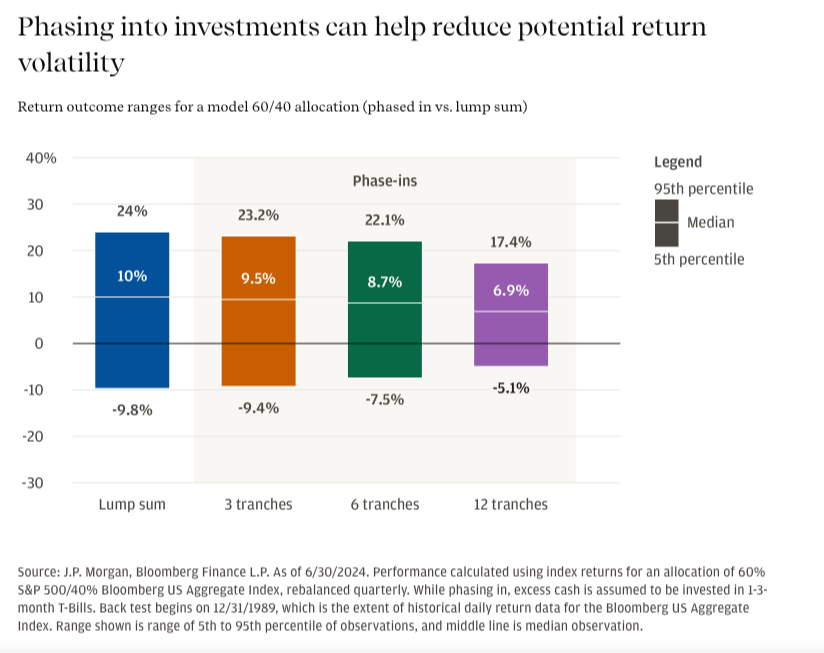
JP Morgan Private Bank, using a standard 60% stocks and 40% bonds portfolio, ran the numbers and came to similar conclusions as Maggiulli: since 1989, lump sum investing had a larger median return, yet investors may need to endure bigger swings along the way to achieve those results.
The author, interpreting the above chart2, writes,
Unsurprisingly, the lump-sum investment approach for our model 60/40 allocation yields the highest median return of 10.0%. Since markets tend to go up over time, being fully invested for longer has been the most profitable choice, on average. However, the range of return outcomes for the lump-sum strategy remains the widest of all our scenarios, ranging from 24.0% to -9.8%. Again, this dynamic clearly demonstrates the trade-off: Compared to investing everything at once, a phased-in approach can narrow the range of potential return outcomes, even though it may lower your median return slightly.3
Life, and investing, is always full of tradeoffs.
Hard to argue with the data though: lump-sum investing wins again.
The question is, can you endure the swings to achieve it?
Remember humans aren’t machines. We aren’t AI.
We have emotions. We are filled with hopes and dreams and fears and anxieties. We live by narratives and stories more than numbers and data.
While the long-term future you will likely thank you for putting all the money to work at once, the short-term future you may not be able to handle doing so.
If you invest all at once and panic in a decline, there will not be an invested long-term future you to reap the possible compounding investment return.
Tim Urban, a writer, blogger, and illustrator, says, “Human behavior is what happens when you put human nature into a given environment."4 And if your lump sum investment decision now puts you into a negative environment you can’t handle two months from now, it is going to be challenging.
Threading the needle on this is part of the job of a trusted wealth advisor.
People like Mr. Maggiulli, who are in wealth management, know the humanity of investing. In a blog on the same topic, he says, “If you are still worried about investing your lump sum today, the problem may be that you’re investing in a portfolio that is too risky for your liking.”5
Good point.
But for new investors, they don’t always even understand what their risk is even if they’ve filled out all the questionnaires and had their first few consultations. This is revealed over time and helps the investor know themselves and advisors know their clients.
The objective “facts” of past performance must consider the range of subjective “experiences” the particular investor is facing now and may face in the future.
Financial advisors can’t predict the future, but they can do their best to align your investment choices now to a future you that stayed invested and investing.
Lump sum investing may win, but phasing in may help investors learn to behave.
If you or someone you know needs help learning how to invest, reach out to us.
--
Sources:
1. Nick Maggiulli. Published on LinkedIn 3 weeks ago: here.
2. Andrew P. VanWazer, “Should You Take the Plunge? Discover the Benefits and Trade-Offs of Phasing Into Markets”, October 15, 2024. Accessed online: https://privatebank.jpmorgan.com/nam/en/insights/markets-and-investing/ideas-and-insights/should-you-take-the-plunge-discover-the-benefits-and-tradeoffs-of-phasing-into-markets
3. Ibid.
4. Quoted by Morgan Housel on X on December 5, 2025. Accessed online: https://x.com/morganhousel/status/1996948461384863806
5. “Dollar Cost Averaging vs Lump Sum [All You Need to Know]”, February 5, 2023. Accessed online: https://ofdollarsanddata.com/dollar-cost-averaging-vs-lump-sum/