


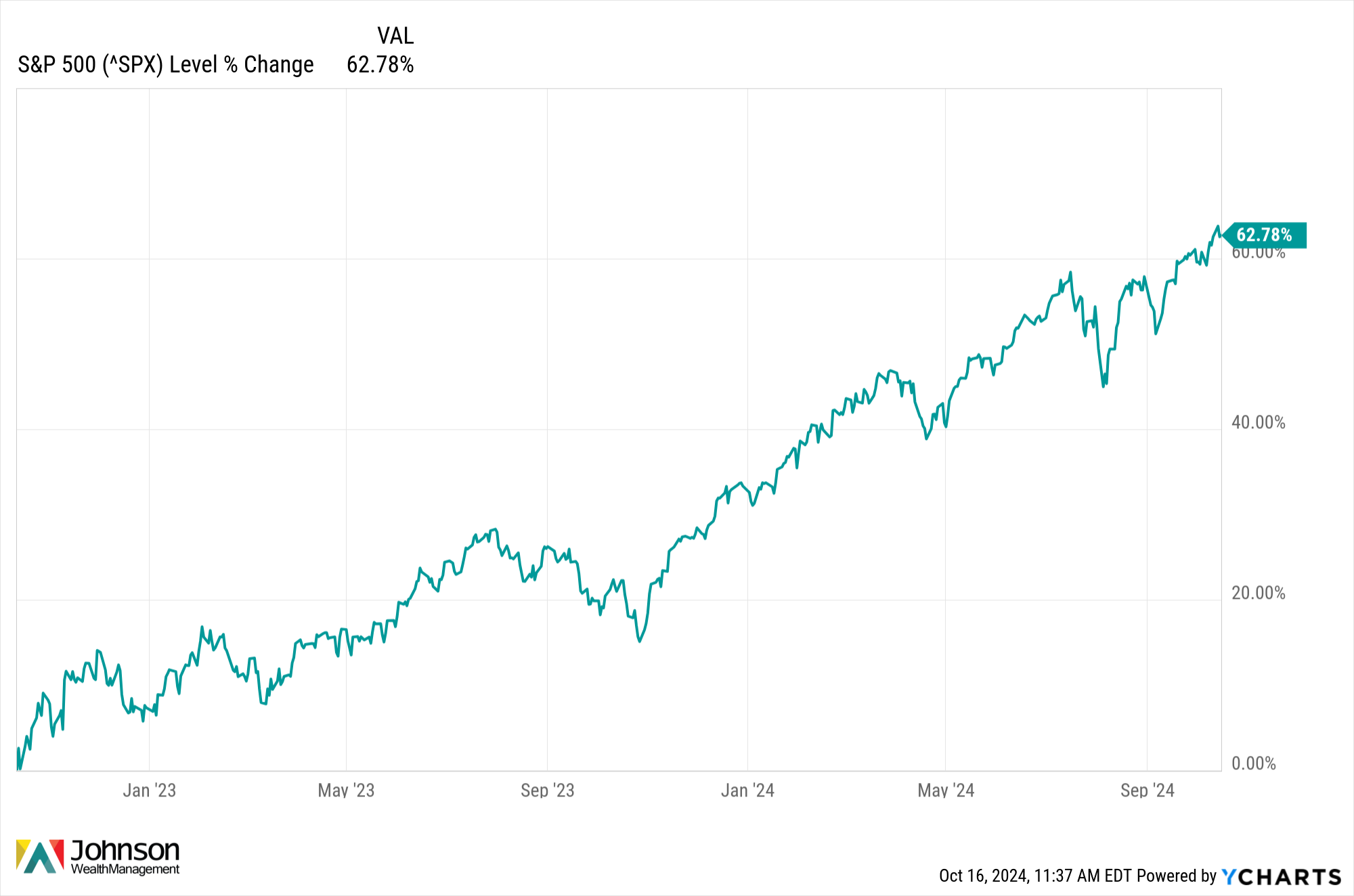
The US stock market’s bull run had a birthday this month.
Barrons notes that it turned two years old on Saturday, October 12th: “up more than 60% from the lows it reached in the 2022 bear market.”1
Wait a sec, you say. What do bulls and bears have to do with the market anyway?
Investopedia answers:
…the terms could come from how these animals attack: a bull thrusts its horns upward, symbolizing rising prices, while a bear swipes its paws downward, representing falling prices.
Thus, a bull market is for a period of rising prices, and a bear market is for when prices are declining.2
In other words, we don’t know for sure, but the symbols work. So go with it.
This bull market has been particularly disliked, with many investors fearing a significant downturn throughout its ascent.
Callie Cox, a Chief Market Strategist, notes that investor sentiment via the AAII survey of individual investors at the end of September 2022 was at its most pessimistic since the global financial crisis of 2008-2009. Yet the market climbed, despite plenty vibes of restraint.3
Why all the hate for this two-year-old bull? Blake Millard lists several concerns that have lingered in the background to justify reasons to sell:
- inflation
- economic recession
- M2 money supply
- the Conference Board’s Leading Economic Indicators (LEI)
- the oil shock
- inverted yield curves
- regional bank contagion
- Japanese yen carry trade
- geopolitical tensions
- the Middle East
- rising fiscal deficits
- AI and the robots coming for our jobs
- etc etc4
Don’t forget this one too: an upcoming Presidential election that gives many the jitters.
There are ALWAYS going to be reasons to sell, but one person’s reason to sell can be another person’s reason to buy.
Surely, now is a time to sell, right? After all, if the stock market is hovering around all-time highs, does this mean it’s expensive?
Depends on how you look at it.
While the S&P 500 is up 38% from May 2021, Matt Cerminaro has shown that earnings growth has made stocks 19% cheaper.5
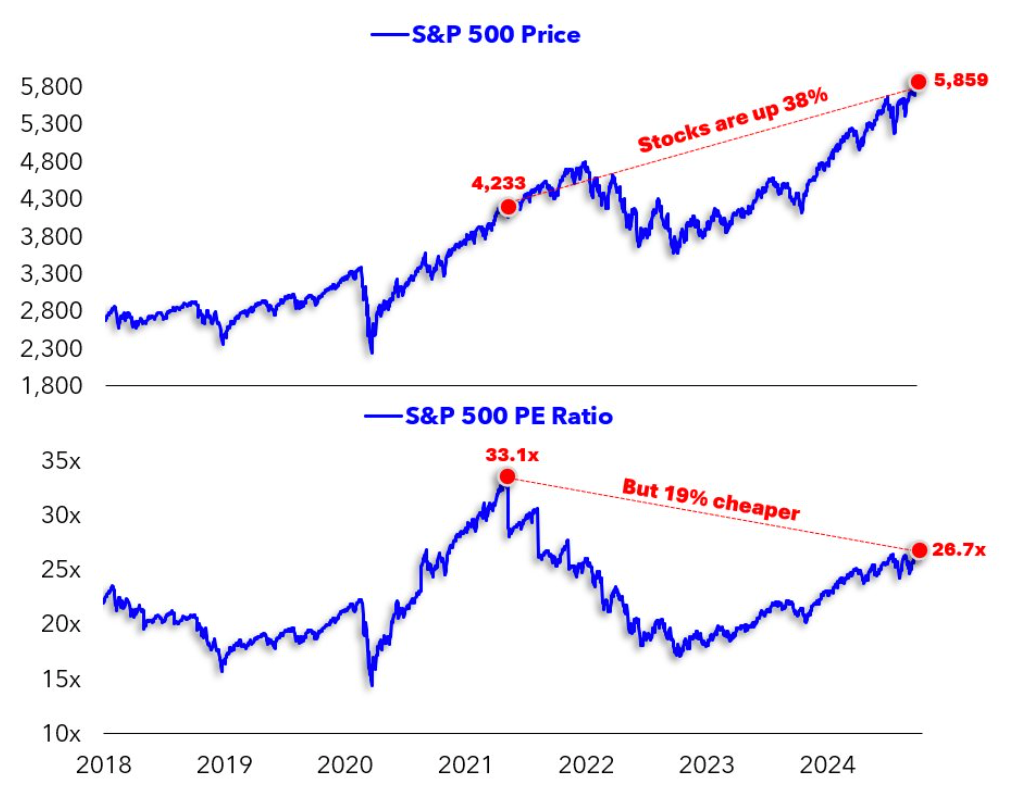
On the other hand, JP Morgan’s data as of the end of September shows the forward P/E ratio at 21.52, above the 30-year average of 16.73 but below late 1990s bubble levels of 24.3.6
Though scary headlines can make everyday investors assume stocks will go down, earnings matter much for the stock market. And earnings season for the third quarter is now beginning.
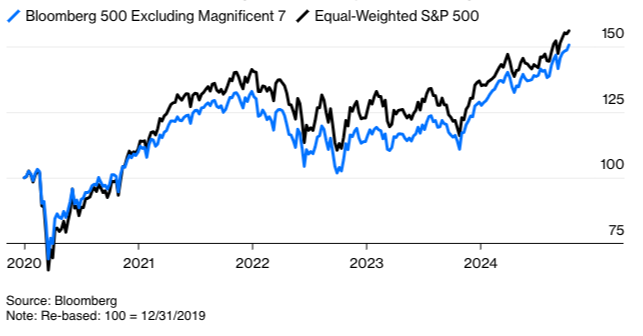
One critique of the stock market’s march up over the last few decades has been the massive role technology stocks via the Magnificent Seven has played. When the market is led by a small select group of companies that can be looked at as problematic. But Bloomberg reveals7 that this bull run has been relatively broad based:
Ryan Detrick gives the short-term bad news and long-term good news for the age of this market:
The good news is this is the third year of the bull market and if they make it this far they tend to have multiple years left in them.
The bad news is the third year tends to be choppy and rather weak.8
One of the primary reasons that keep investors from making good returns on their investments is infatuation with the short-term over the long-term.
We are prone to let the news and our feelings be our guide instead of charts like this9:
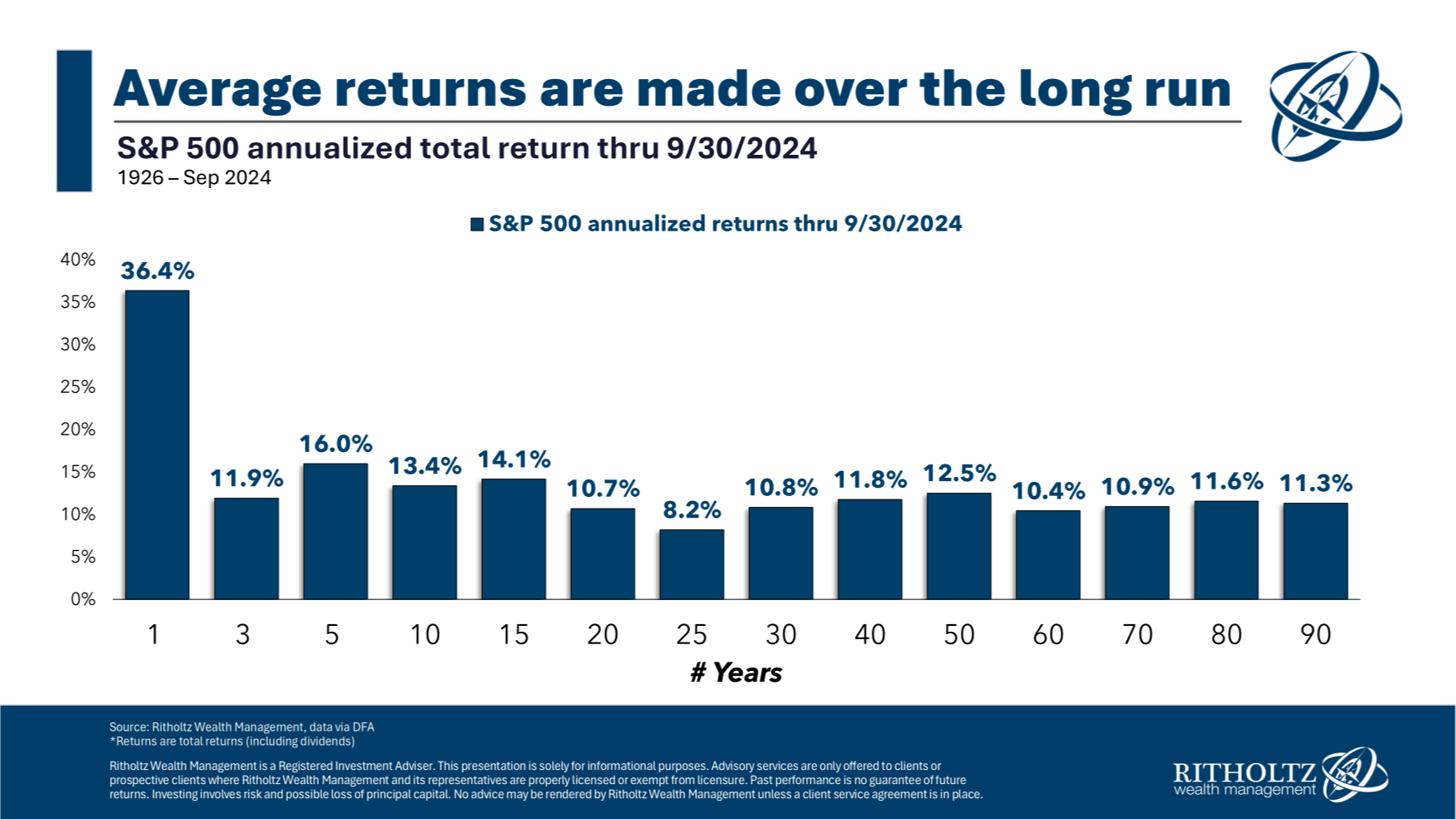
Now that is worth your attention regardless of when this current bull market eventually ends.
Success in the stock market is a marathon not a sprint.
Two years is a blip.
---
Sources:
- “The Stock Market Bull Just Turned 2. Can it Survive the Election?”, published October 14, 2024 by Teresa Rivas. Accessed online: https://www.barrons.com/articles/stocks-bull-market-whats-next-5ab0b76d
- “Where Did the Bull and Bear Market Get Their Names”, Mary Hall on June 28, 2024. Accessed online: https://www.investopedia.com/ask/answers/bull-bear-market-names/#:~:text=However%2C%20the%20terms%20could%20come,for%20when%20prices%20are%20declining.
- “Happy birthday, bull market”, published October 14, 2024. Accessed online: https://www.optimisticallie.com/p/happy-birthday-bull-market
- Taken from his “The Sandbox Daily” email dated Friday, October 11, 2024.
- Posted on X on October 14, 2024. Accessed online: https://x.com/mattcerminaro/status/1845929534673084882
- “Guide to the Markets”, page 5. Accessed online: https://am.jpmorgan.com/us/en/asset-management/adv/insights/market-insights/guide-to-the-markets/
- “Markets Return to a Trump Tipping Point” published on October 13, 2024 by John Authers. Accessed online: https://www.bloomberg.com/opinion/articles/2024-10-14/markets-return-to-a-trump-tipping-point
- Posted to X on October 15, 2024. Accessed online: https://x.com/RyanDetrick/status/1846375627529625732
- “Long-Term Stock Market Averages”, Ben Carlson, on October 13, 2024. Accessed online: https://awealthofcommonsense.com/2024/10/long-term-stock-market-averages/