


A dog took me out at the knees last week.
It was painful and provided me with investing illustrations galore.
I like to run, and at the beginning of one of my routes, I found myself knocked to the ground with a moving creature enveloping me.
I didn't see it happen. I felt it happen. The stock market is like that. The triumph and terror of sudden volatility.
That's the risk you take when you exercise with AirPods blasting music straight into your cochlea.
Noise can be distracting for runners and investors. Our attention is caught up in our favorite news channel or podcasts. Sometimes we are looking or listening in the wrong place.
Having been bitten before as a teenager, I immediately prepared myself for another munching.
Thankfully, it turned out to be one of those annoyingly anxious yet otherwise amiable dogs that enjoys a jog whenever its owner arrives home from work. Thrilled to be outside, to release the pent-up energy of being enclosed all day, the dog found another human running too. So the pooch, in all its tail-wagging canine glee, decided to come with. What it meant by "come with" was come in between each of my moving legs.
The good news is I didn't lose any more skin than I had already lost from the fall. I had not been bitten.
The happy beast proceeded to flee down some other street on its merry way through undiscovered neighborhoods. I, on the other hand, can assure you that if I had a tail, it would not have been wagging.
I stood up feeling the pain that comes from a 45-year-old body being flattened to the cement with an elbow gashed and hip bashed.
The pet parent said, "Are you alright?"
I paused and glared, replying, "I'll know in a few minutes."
I was silent, shaking my head, eyes shooting anger beams.
Let's be honest. The only thing worse than seeing the infamous dog is seeing the owner of said dog.
What you really want to say in that moment is a sarcastic, "What do you think?" Or something uglier that sounds like this looks: "!#%$@&^!"
Ever said that to your investment portfolio or CNBC?
By God's grace, I kept it clean, and eventually announced, "I'm all right."
Plus, I had a choice to make: walk home limping, nursing my wounds, or continue running a 5K before the soreness got worse.
This decision mirrors what every investor must do when facing inevitable market declines—sell, sit, or buy more.
I chose to run.
Earlier that day, I had been speaking to a client about market risks—specifically about how sometimes it's the things that no one sees coming that derail the stock market. That was not a prediction. It was simply a risk management conversation that a financial advisor must have, especially when markets are soaring. Everyone embraces risk when stocks are rising. They don't like it so much when the market takes a beating.
Here's the thing: Stocks don't always go up. Sometimes things can hum along wonderfully when seemingly out of nowhere a correction—or even a crash—comes. In investing parlance, we don't call these dogs; we call them Black Swans—rare, unexpected events that carry significant impact. These events, like my canine encounter, can appear without warning and knock you off your feet.
The S&P 500, our primary benchmark for U.S. large-cap stocks, has experienced many knockdowns over the last thirty-five years:
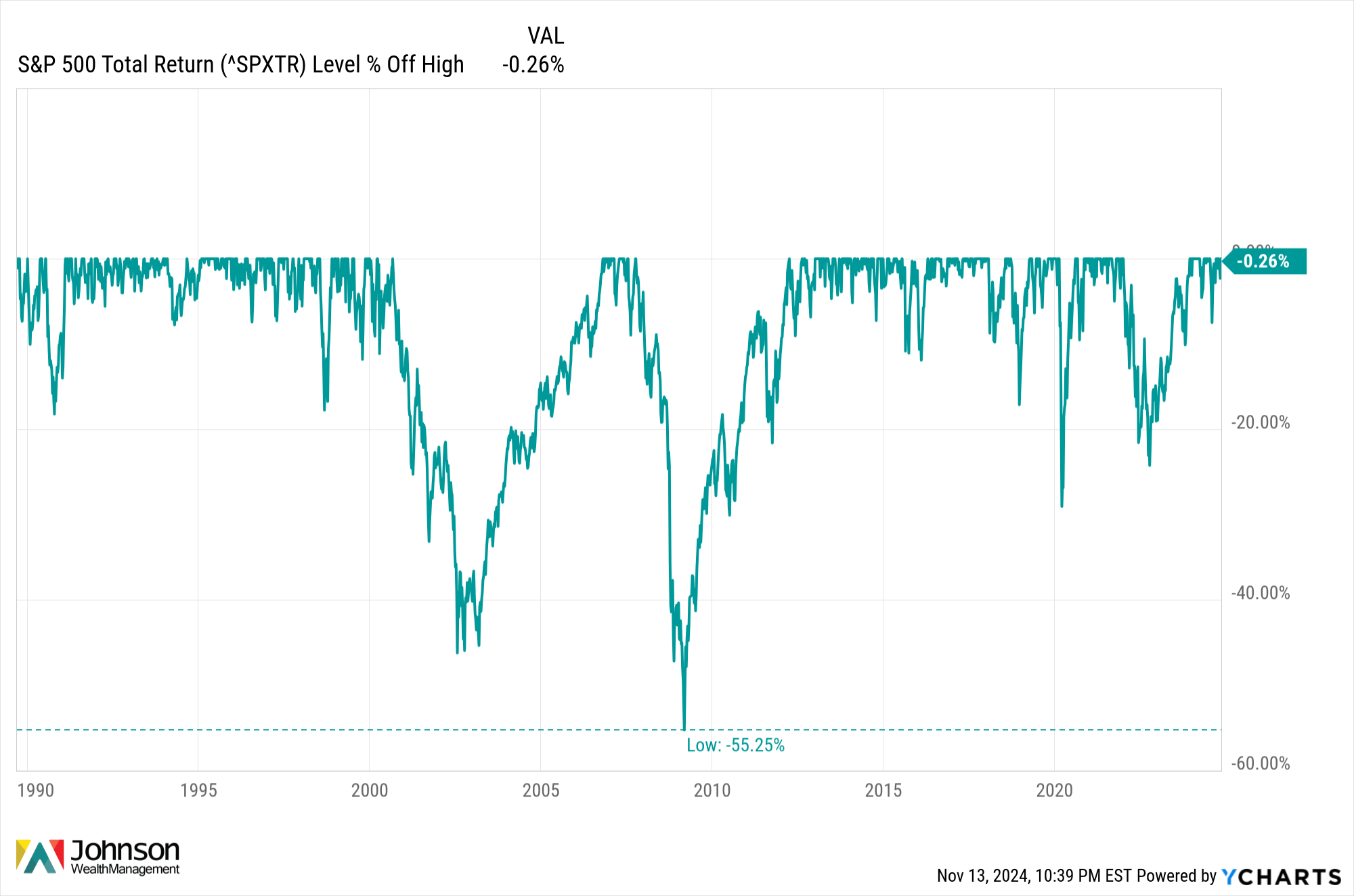
These market corrections will happen again. When? Who knows.
The critical question isn't if disruptions will occur, but rather: will you keep investing? Or will you quit, take your bag and go home?
Fitness goals demand discipline, so do financial ones. Reality bites—or at least knocks you over—sometimes. Successful investors play the long game anyway.
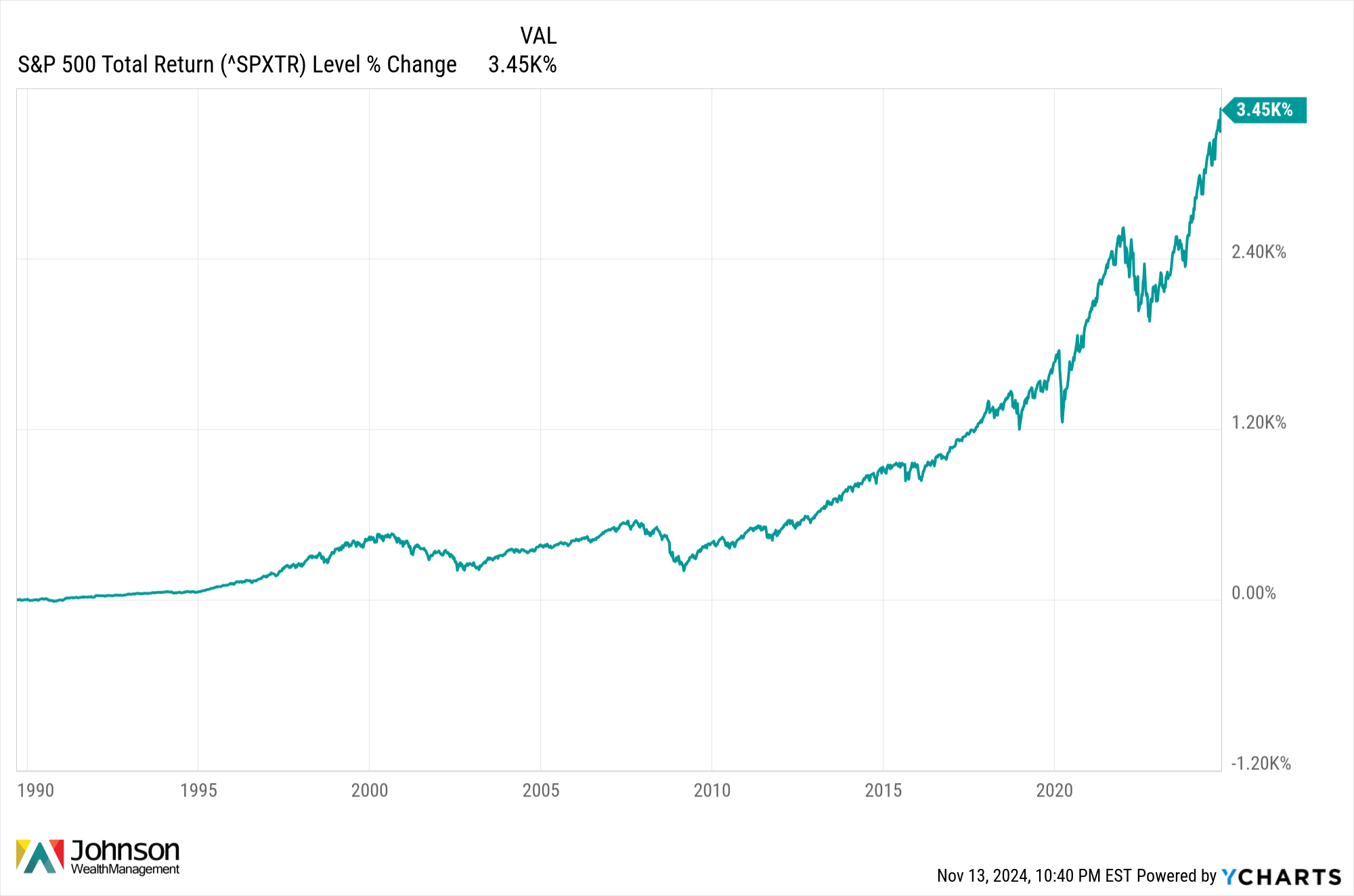
This is not a forecast of doom and gloom. History shows that optimistic investors have triumphed over the long haul in the U.S. stock market. By far.
Consider how the same time period shown above looks when we zoom out to see the S&P 500's impressive 3,450% total return:
So, what can you do? Know your financial goals, understand your risk tolerance, study your stock market history, and maintain appropriate diversification and guardrails. But knowing about something is a far cry from experiencing it. Experience separates wise investors from foolish ones.
Life is risky. Running is risky. Investing is too.
But I choose to keep running. The physical and mental payoffs have been a blessing.
Those who have kept investing through the bumps and bruises have likely been blessed too.
But my goodness, the bruises along the way can hurt.
This shouldn’t surprise us.
There is no good story—or financial story—without getting knocked down.