


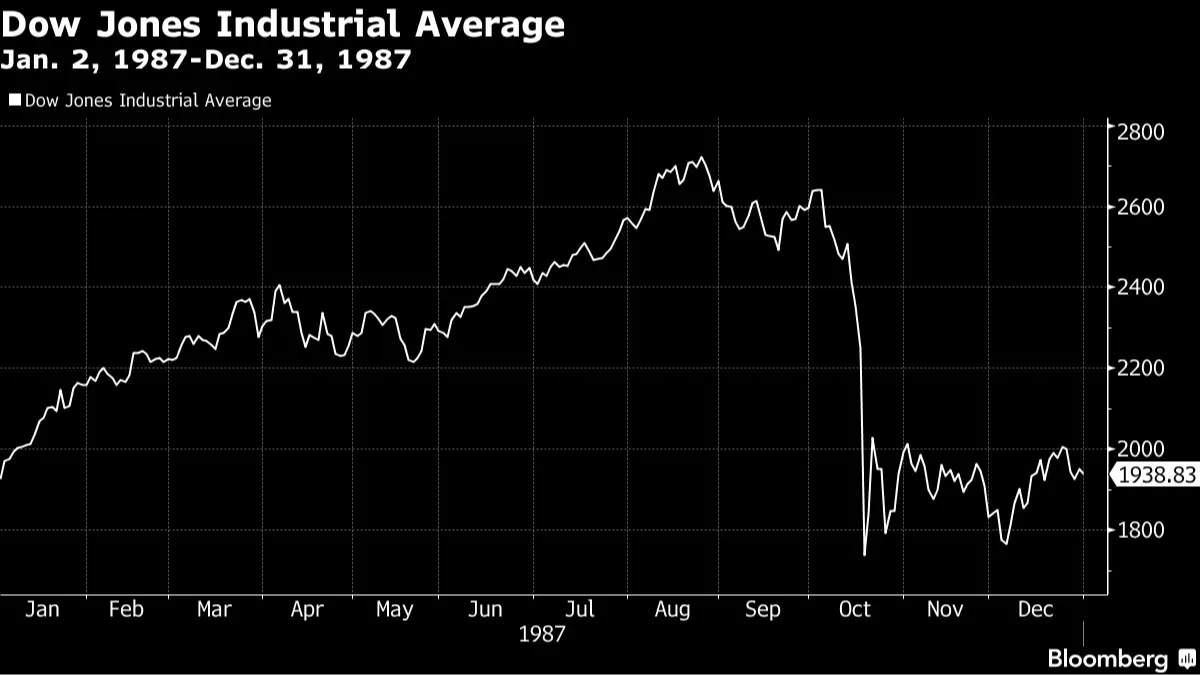
You see that sharp line pointing down in the above chart?
That’s the evaporation of value within investment portfolios.
They call it Black Monday.
Yesterday was the anniversary of that debacle on Wall Street.
If you had been 100% invested in the Dow Jones Industrial Average in your retirement account, about 23% of your value would have disappeared in a single day.
Art Cashin, the legendary director of floor operations for UBS, spoke to the drama of that day: “It was an incredible time, and the financial system was within hours (and a few phone calls) of an absolute collapse. It was a time I’ll never forget.”1
We haven’t experienced something like that in markets for some time, though April of this very year spooked investors quite a bit. The Wall Street Journal notes:
As of mid-morning Monday, the S&P 500 is down around 14% over the past three trading sessions. That puts it on course for its largest percentage decline over such a period since October 1987, around the Black Monday market crash, according to Dow Jones Market Data.2
Howard Marks, the celebrated fixed income investor, describes one lesson he learned from that day in 1987: “It really reinforced the idea that anything can happen in the market and it doesn’t require a rational process.”3
Despite the best efforts of many to predict what is going to happen, the stock market is not predictable.
We have circuit breakers now that can help curb the contagious selling by stopping trading for a bit, but the point remains: stocks are not always rational, and when selling pressure hits, rationality goes out the window.
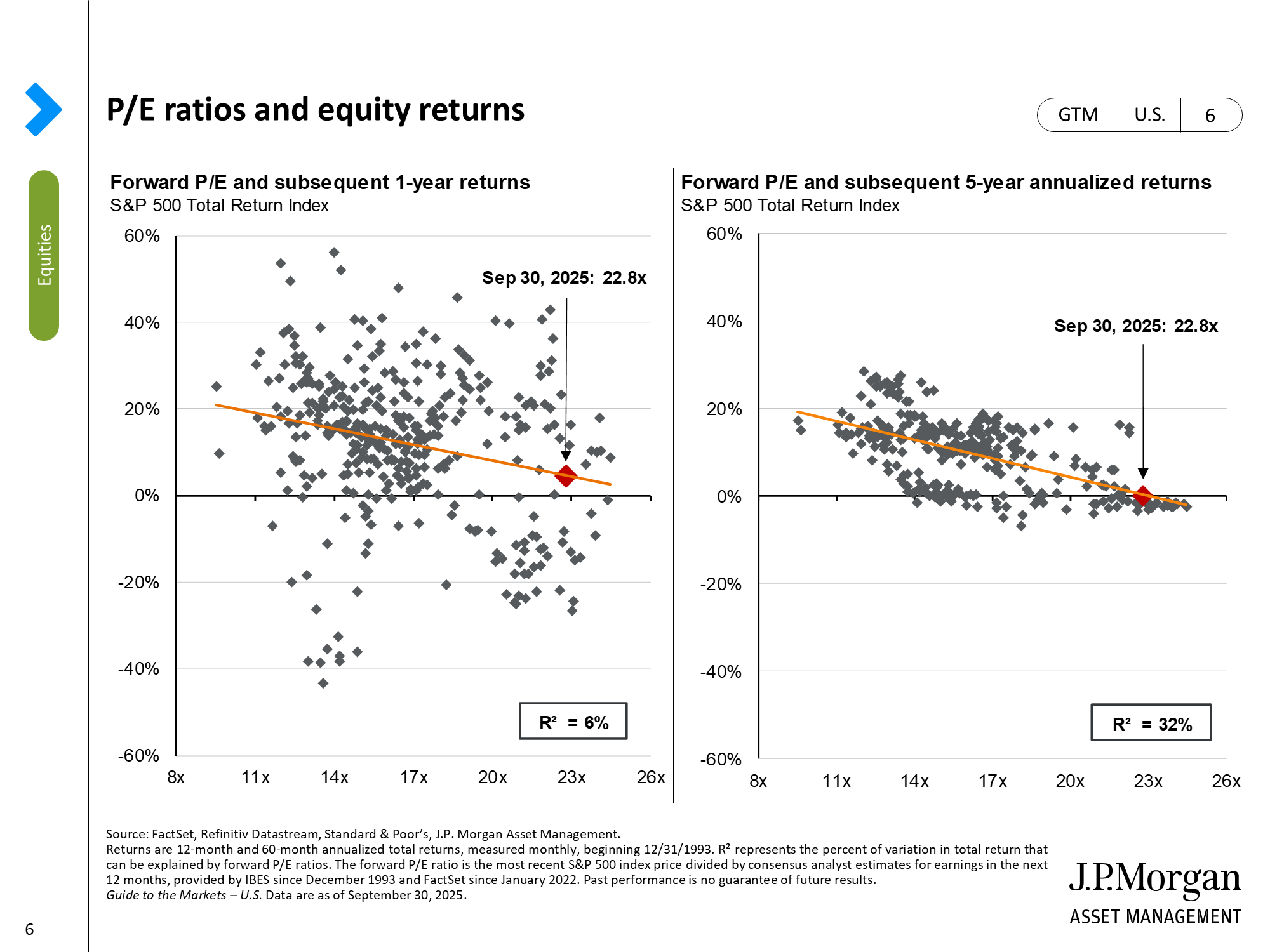
Lately, one fear that has been on investors’ minds is the potential of a bubble due to artificial intelligence and high market valuations. Future 5-year returns have not been good when forward P/E ratios are where they are at.
Before you go totally bubblehead though, remember that it’s helpful to realize that just because a bunch of people are talking about a bubble, it doesn’t mean we are in one.
Though there are signals, they are easier to identify in hindsight. Unfortunately, bubbles are typically discovered when they pop.
Like relationships, they fall apart slowly and then all at once.
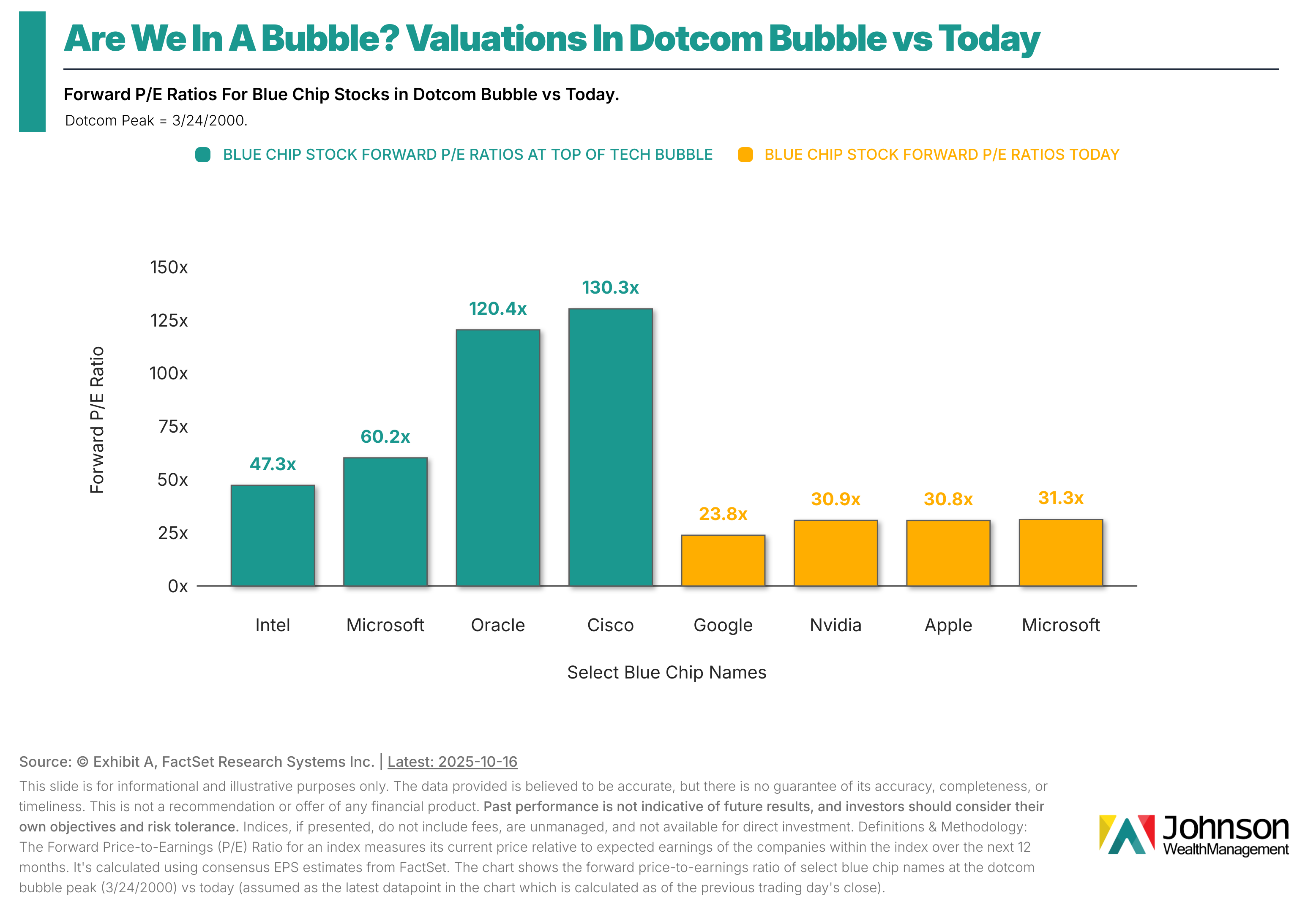
Furthermore, some valuations of the largest companies now versus the largest companies during the tech bubble are not nearly as outlandish.
The key takeaway is to understand that there will always be conversations about where the stock market might be headed. Investors need to know that volatility is the subscription price of investing.
To receive 10.5% annual returns since 19904, you had to experience some very dark days and years in stocks.
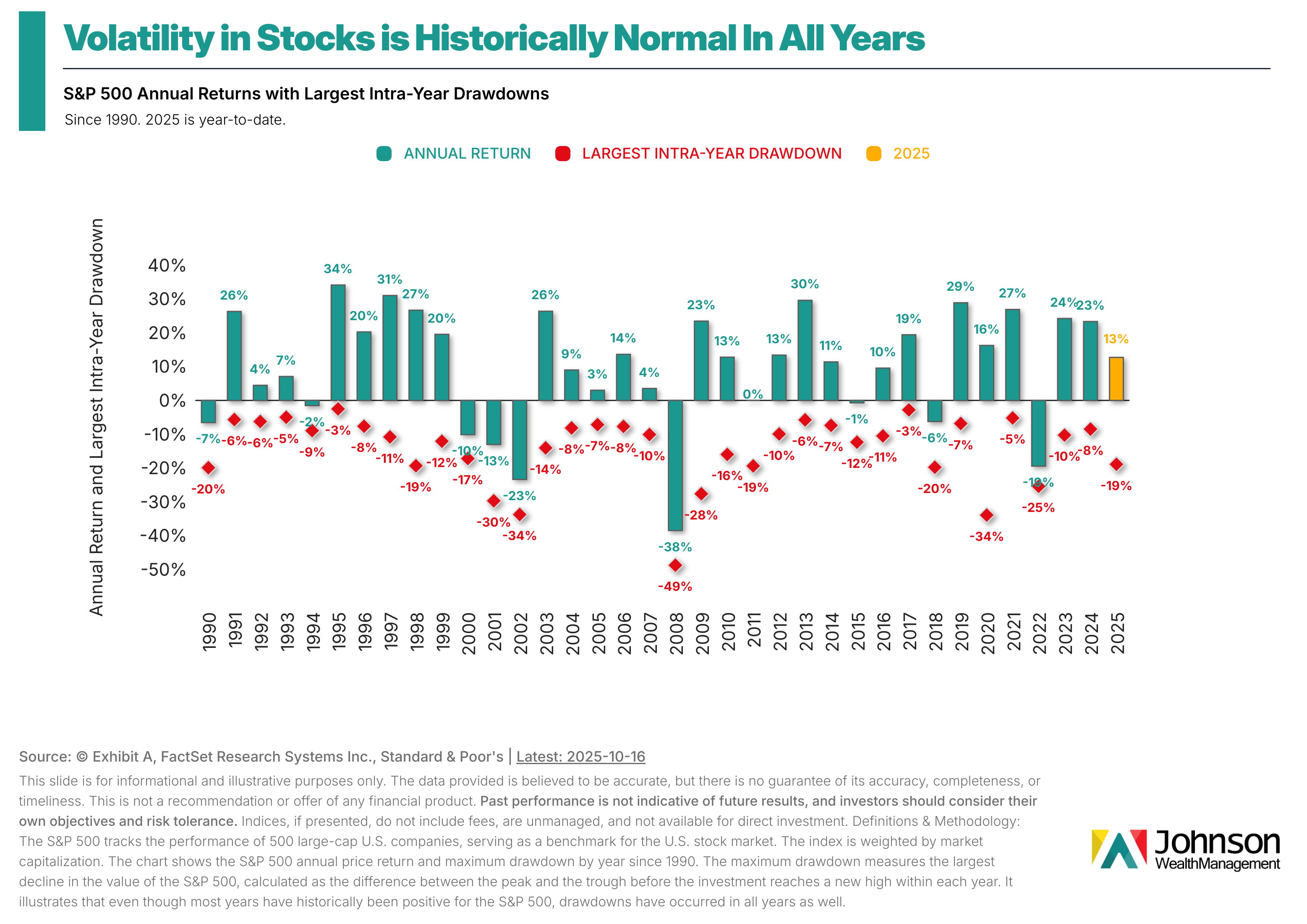
Patient investors know that though there may not be a way around the volatility (selling at just the right moment and buying at just the right moment is nearly impossible), history has shown that the way to get through it is by going through it.
Don’t let a bubble or a Black Monday event be the only time you reevaluate your risk tolerance and reexamine your financial goals.
That’s like evaluating your safety plan in the middle of a significant earthquake. It’s too late.
Do it when the earth isn’t shaking. If you need help in doing so, reach out to us.
—
Sources:
- “Market legend Art Cashin remembers Black Monday 30 years Later”, October 19, 2017. Accessed online: https://www.cnbc.com/2017/10/19/market-legend-art-cashin-remembers-black-monday-30-years-later.html
- “Black Monday? The S&P 500 is Crashing Like It's 1987”, Gunjan Banerji, April 8, 2025. Accessed online: https://www.wsj.com/livecoverage/stock-market-trump-tariffs-trade-war-04-07-25/card/the-s-p-500-is-crashing-like-its-1987-LFle8lqtnOOP7EwZZElf
- Quoted in “The Crash of ’87, From the Wall Street Players Who Lived It”, October 16, 2017. Accessed online: https://www.bloomberg.com/news/features/2017-10-16/black-monday-at-30-wall-street-remembers-the-1987-stock-market-crash
- Exhibit A.