


You can find a whole lot of chatter about a stock market bubble due to high prices and AI.
If there is a ton of talk about something being a bubble, is it?
Recently, Howard Marks, of Oaktree Capital, said it like this:
If enough people are cautiously wondering if there’s a bubble in a given area, then it makes absolute sense to think that if it is a bubble, it’s probably restrained…1
I don’t know if it’s a bubble or not, and you should know by now that I don’t predict the direction of markets.
But one thing I notice about the general public is that they can assume that high prices mean that the market is overinflated. Or that since their favorite news channel and social media feed are calling for one—there must be one.
While we are on the topic: just because someone got a bubble or recession call right in the past does not mean that they are right about spotting one in the future. Especially if they keep calling for the same thing over and over. I dealt with this kind of thing in the past in my YouTube video: Rich Dad, Poor Investment Advice: Learn How Fear Fuels Our Investment Decisions.
You know that old saying about a broken clock? You won’t get a pat on the back from me for scaring people spitless for a decade or more, only to finally get it right.
Amid all the noise, it’s easy to forget a key ingredient in how the stock market works.
Did you know that stock prices can go higher and the stock market can get cheaper at the same time?
On October 20th, Duality Research illustrated how this works:
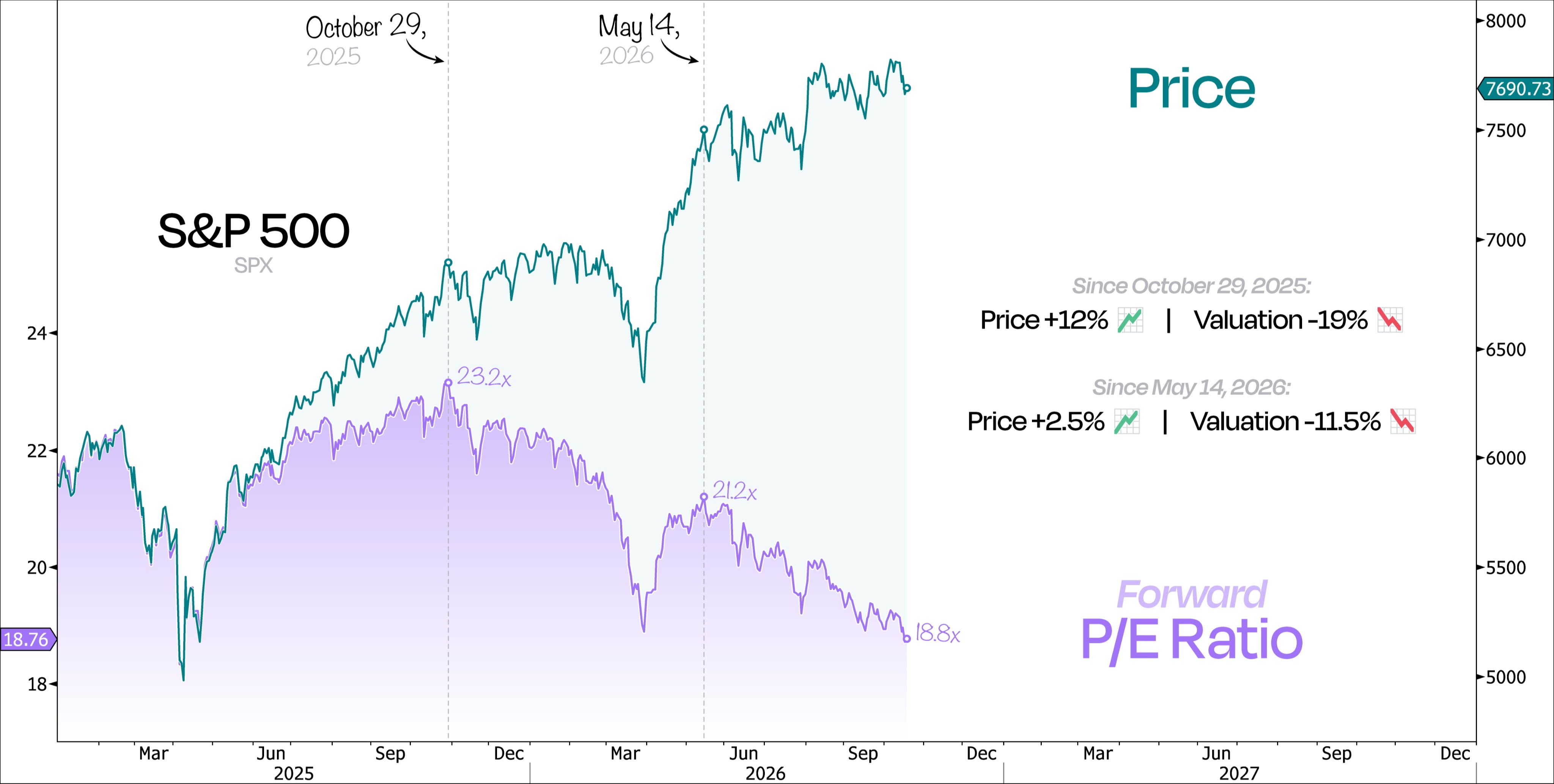
Here are the details in their own words:
Since the valuation peak after the Tariff Tantrum bottom, the S&P 500 has rallied another 12% 📈, despite valuations compressing by 19% 📉.
Since the valuation peak following the Iran War bottom, we're up another 2.5% 📈, even as valuations have contracted another 11.5% 📉.2
Prices and valuations have changed a bit since this post last week.
But one thing is for sure…
You cannot look at the price of the stock market alone as a reason to buy or not to buy.
Too many have made the mistake of NOT buying because they think stocks are high. Then stocks just keep going higher.
The opposite is also true. Some have bought because they think the price will keep going up when there are no earnings or underlying fundamentals to support it. The bearish case in our current situation is that expected AI earnings won’t materialize to support current prices. We shall see.
Still, the general principle stands.
Make sure your investment decisions are shaped by more than price alone.
—
Sources:
1. “Billionaires Warn of a Bubble Yet Howard Marks is Unconvinced”, October 18, 2026. Accessed online.
2. Posted on X on October 20th, 2026. Accessed online.